When you buy through links on our articles, Future and its syndication partners may earn a commission.

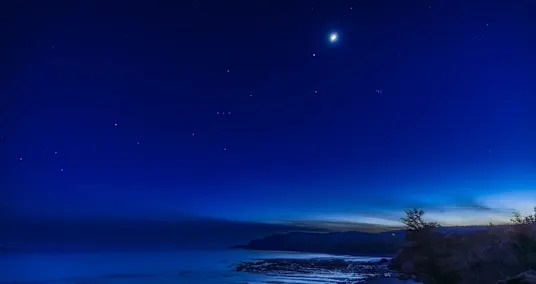
Look to the east at sunset tomorrow (March 26) to see the half-lit form of the waxing gibbous moon shining close to the gas giant Jupiter in the evening sky, as the bright stars of the constellation Gemini twinkle nearby.
The moon will make its closest approach to Jupiter at 9:19 EDT (1319 GMT) on March 26, at which time Jupiter will be lost to sight in the daytime sky. The pair will remain close throughout the evening, however. Viewers in the northern hemisphere will get their best view of the solar system pairing at sunset, when the moon will appear with its right side lit by sunlight high above the southern horizon, less than a day after reaching its first quarter phase.
Jupiter will appear as a steady star-like object glowing brightly 5 degrees to the lower right of the lunar disk — roughly the width of your three middle fingers held at arm's length against the sky. To the upper right shine Castor and Pollux — the bright stars that represent the heads of the celestial twins depicted in the constellation Gemini.
The moon and Jupiter will make for a gorgeous sight through the eyepiece of a 6-inch telescope, which will reveal the dark lunar seas and prominent craters lining the night-day divide on the lunar surface, along with the cloud bands of the gas giant and its most prominent moons.
As the night wears on, the lunar disk will appear to travel away from Jupiter in Earth's sky, before finally disappearing from view below the northwestern horizon shortly after 3 a.m. EDT (0700 GMT) for viewers in New York. Visit Time and Date to discover the exact times that solar system bodies like the planets rise and set from your location.
Jupiter is set to remain a prominent sight in the spring sky until mid-July, when it will become lost into the glow of the setting sun ahead of its solar conjunction on July 29, according to in-the-sky. At that time, Jupiter will be too close to the sun from our perspective on Earth to be visible.
Want to get a closer look at the moon and Jupiter? Then be sure to check out our picks of the best telescopes and binoculars for exploring the night sky. If you're into photography then you may also want to read our picks of the best cameras and lenses for astrophotography, along with our roundups of the finest smart telescopes available in 2026.
Editor's Note: If you would like to share your astrophotography with Space.com's readers, then please send your photo(s), comments, and your name and location to [email protected].
LATEST POSTS
- 1
 Unsold Rams May Be Less expensive Than You Suspect
 - 2Germany ready to assist Syria's reconstruction, says foreign minister
- 34 astronauts are en route home from ISS after medical issue forces early exit
- 4Wizz CEO: We’re going to invest $1 b. in Israeli market
- 5Africa's energy giants eye long-term gains on Iran war disruption





- I asked ChatGPT who would win a Golden Globes. Here's what it got right — and totally wrong.
- Watch Blue Origin's huge New Glenn rocket ace its epic landing on a ship at sea (video)
- Which European countries have mandatory or voluntary military service
- South Korea to End Bear Bile Farming and Find New Homes for the 200 Bears Stuck in the Industry
- Parents who delay baby's first vaccines also likely to skip measles shots
- Gaza amputees struggle to rebuild lives as the enclave faces shortages of prosthetic limbs
- EU delegation urges China to tighten export controls
- Instructions to Boost Your True capacity with a Brain research Degree
- Uranus's small moons are dark, red, and water-poor